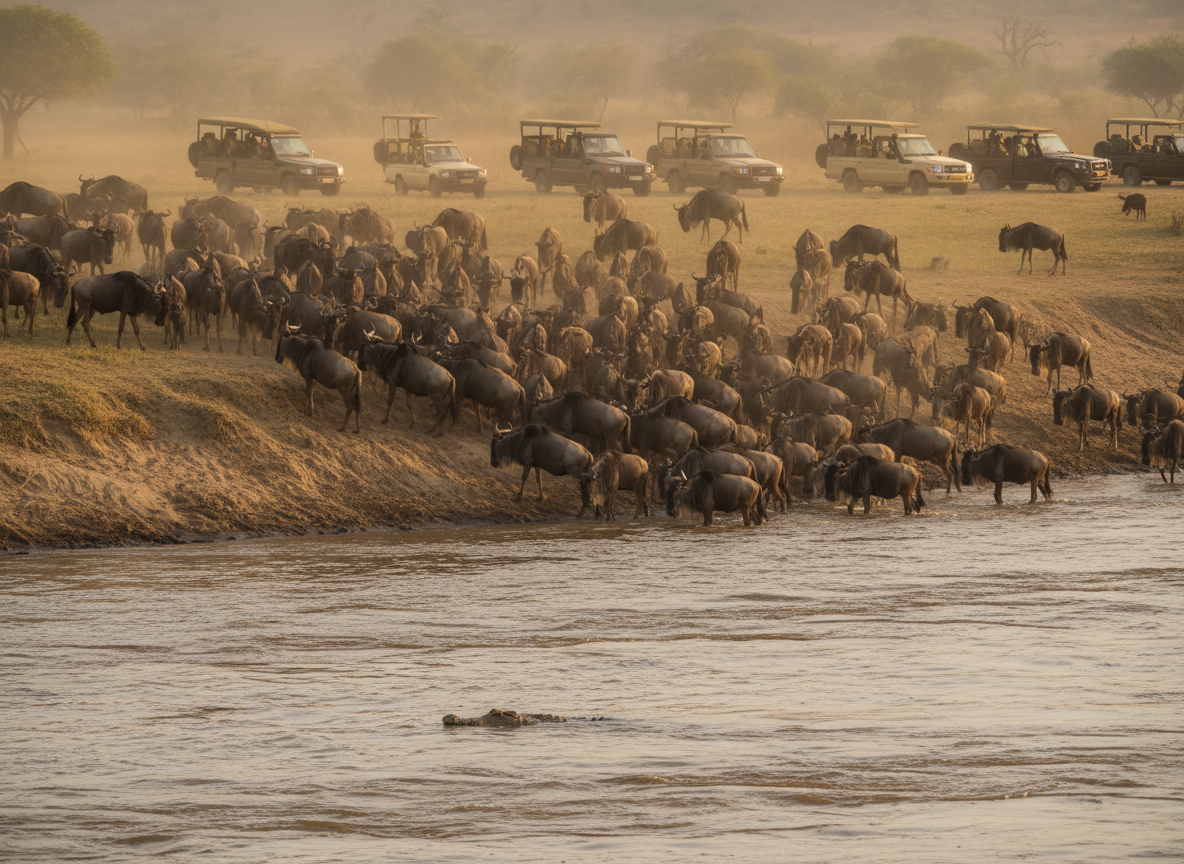
Every year, photographs of Mara River wildebeest crossings circulate as if the event is pure, untouched natural spectacle. Many of those photographs are taken from a line of forty vehicles parked bumper-to-bumper at the bank, engines idling, some positioned in the water itself to channel the herd toward the cameras.
That is not a fringe occurrence. It happens regularly at the most popular Masai Mara crossing points during peak season.
Understanding what a responsible wildebeest migration safari in Kenya actually looks like, and how to identify operators who follow those standards, is the most practical piece of research a migration-focused traveller can do before booking. This guide covers the standards, the questions to ask operators before you pay a deposit, and what your presence at the crossing actually costs the ecosystem when the vehicle behaviour is wrong.
Why This Matters: The Ecological Impact of Bad Vehicle Behaviour
The wildebeest migration is not a performance. It is an ecological event driven by grassland availability and rainfall patterns, running on a cycle that has continued for millions of years. The animals cross the Mara River because the grass on the other side is better, not because there is an audience.
When safari vehicles drive into the water to channel herds, rev engines to accelerate crossings, or crowd the exit bank to trap animals for longer photography windows, they are disrupting behaviour that affects real outcomes. Stressed wildebeest abort crossings. Calves get separated from their mothers. Crocodile-driven mortality increases when the natural flow of a crossing is disrupted by vehicle positioning.
Research from the Masai Mara Research Centre and Kenya Wildlife Service has documented these effects clearly. A key finding: crossings where more than fifteen vehicles are in close proximity have a 40 percent higher rate of premature abort. The animals respond to vehicle pressure. The crossing behaviour you want to witness is directly affected by how your operator behaves at the bank.
What Ethical Vehicle Positioning Looks Like
The difference between responsible and irresponsible positioning at a Mara River crossing is observable and specific.
Responsible positioning:
- Vehicles parked parallel to the bank, not angled toward the water
- Minimum 20 metres back from the bank edge
- Engines off or in neutral to reduce noise disturbance
- No vehicles in the water at any point
- No more than 10 to 12 vehicles per crossing point before the guide redirects to an alternative location
- No vehicle overtaking or aggressive repositioning once a crossing begins
Irresponsible positioning:
- Vehicles at the bank edge with engines idling
- Vehicles driving into the river shallows to channel the herd
- Multiple vehicles on the exit bank blocking natural dispersal
- Guide positioning the vehicle based on camera angles rather than animal behaviour
The key distinction is intent. A guide focused on wildlife welfare positions for the animal’s natural behaviour. A guide focused on producing a guaranteed sighting positions for the photograph, and the two approaches are not always compatible.
How to Evaluate an Operator Before You Book
A responsible migration safari is identifiable at the research stage if you ask the right questions. These four questions separate operators who have thought about crossing ethics from those who have not.
Ask: What is your crossing protocol? A responsible operator will describe their positioning standard, their maximum vehicle proximity policy, and their engine protocol at crossings. An operator who cannot answer this question specifically has probably not briefed their guides on it.
Ask: Do you guarantee a crossing? No legitimate operator can guarantee a crossing. Crossings are wild, unpredictable events. An operator who promises one is either making a misleading commercial claim or using disruption tactics to produce the event on demand. This is a direct red flag.
Ask: What happens when there are too many vehicles at a crossing point? The right answer is clear and specific: we move to an alternative crossing point or return at a different time. An answer that involves holding position competitively is the wrong answer.
Ask: Are you licensed by the Tourism Regulatory Authority? is a basic filter in Kenya. Unlicensed operators are not accountable to industry standards in the same way and are more likely to operate without any crossing protocol at all.
| Indicator | Responsible Operator | Non-Responsible Operator |
|---|---|---|
| Guarantees crossing | Never | Often |
| Crossing positioning | 20m+ back, engines off | At bank edge, engines on |
| Response to vehicle crowds | Moves to alternative location | Competes for position |
| Guide briefing on protocol | Documented | Informal or absent |
The Conservancy Advantage for Ethical Migration Viewing
The crossing events that cause the most documented ecological damage happen in the National Reserve sections where vehicle density is highest. The private conservancies surrounding the Mara, including Olare Motorogi, Mara North, Naboisho, and Ol Kinyei, operate under stricter vehicle management with formal limits on the number of vehicles per crossing point.
In a conservancy, your vehicle may be one of two or three at a crossing point. The wildebeest approach naturally. They cross without pressure from vehicle noise or positioning. They disperse on the far bank without obstruction. This is what the crossing looks like when it is not disrupted by competitive vehicle behaviour.
The conservancy daily fee over the National Reserve entry cost is typically $80 to $100 per person per day. For migration-focused visitors, this is the single most impactful expenditure they can make for both experience quality and wildlife welfare. The crossing you pay the premium to witness is a substantially different event from what happens at overcrowded national reserve crossing points.
What Your Visit Funds: The Conservation Economics of the Migration
A well-structured migration safari contributes to conservation through two practical channels.
Tourism revenue to conservancy management: Conservancy fees go directly to land management, anti-poaching operations, and community benefit programmes for Maasai landowners. The land that forms the conservancy buffer around the Mara is privately owned. Without conservancy fee revenue, that land reverts to subsistence agriculture, which permanently fragments the migration corridor. The corridor that wildebeest use to enter Kenya from Tanzania exists because it is economically worth more intact than developed. The fees you pay as a visitor are part of that equation.
Operator conservation contributions: Some Kenya-based safari operators contribute a percentage of each booking to corridor protection and wildlife conservation work. When evaluating operators, ask specifically whether they have a documented conservation contribution mechanism and what it funds. A specific answer about where the money goes is a meaningful credibility signal.
Responsible Photography at the Crossing
Wildlife photography at the migration crossing is high-intensity, emotionally charged work. It is also where visitor behaviour can slide most easily into the irresponsible category, because the desire to get the image is powerful and the consequences of bad behaviour are diffuse.
The ethical standards for photographers at crossings:
Stay inside the vehicle. Standing on seats or extending through roof hatches beyond the standard permitted range creates disturbance and is prohibited at most crossing points.
No audio playback. Playing predator calls or other wildlife audio to influence animal behaviour at a crossing is prohibited under Kenya safari standards and disrupts natural behaviour in ways that extend beyond the immediate event.
Do not request mid-crossing repositioning. Moving a vehicle while a crossing is in progress creates new disturbance vectors at exactly the wrong moment. Brief your guide on this before you arrive at the bank, not after the herd has already committed to the water.
Enforce your own standards. If your guide is positioning in a way that would impede animal movement or block the exit bank, say something. Your guide works for you. Asking them to hold a wildlife-first position is a legitimate use of the expertise you are paying for, not an inconvenience.
Explorer Notes: What to Look for When Booking
The most reliable filter for an ethical migration operator is specificity. Any operator who can describe their crossing protocol in clear, operational terms has actually thought about it and briefed their guides accordingly. Any operator who pivots to marketing language when you ask about wildlife welfare standards probably has not.
Secondary signals to look for:
- Conservancy-based camps in their migration itineraries, not only national reserve
- Guides with documented Masai Mara experience across multiple seasons
- No crossing guarantees in their marketing materials
- A clear position on what they do when a crossing site is overcrowded
For the full context on what migration season looks like across the Masai Mara, including wildlife, timing, and experience differences compared to non-migration season, the Masai Mara migration season guide covers the planning picture in detail. For month-by-month herd location and crossing site guidance, the wildebeest migration tracker maps the full circuit across 2026.
Trunktrails Safaris is a Kenya-based operator running migration safaris with specific crossing protocol briefings for their guides. Their wildebeest migration route and Mara River guide covers the annual movement pattern and crossing site geography in additional detail.
Prefer a different route, budget, or travel style? This plan can be adapted to fit.
Customise Your Trip